
Model Card Template
Document purpose, training data, performance metrics, and known limitations of each AI model in a standard format — the sheet any auditor, client, or internal team can read in 5 minutes.
 See preview ↓
Before you buy
Check whether this resource fits your task
- Formats listed
- Word
- Language
- English
- Indicative difficulty
- Intermediate
What is included
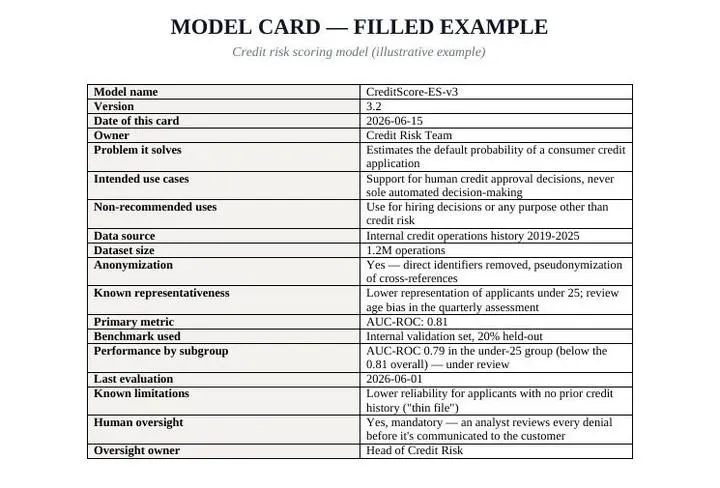
- Word with the Model Card template: intended purpose and use cases, training data and method, performance metrics by benchmark, known limitations and non-recommended uses, version history
- A fully filled-in example from start to finish
- Legal Notice
What you need to complete
- Your organisation’s scope and uses
- Internal responsibilities and criteria
- Review and approval before applying it
Difficulty describes the adaptation work. Review the result with the people responsible for its use.
Preview
Open a sample to zoom in. These are partial views of the file; adapt any examples to your context.
Real screenshots of the file you receive. The full document includes much more content.

What changes with this document
At the «Technical documentation» stage of the path
If an inspection shows up tomorrow, there's nothing to show.
Model card and declaration of conformity, ready for an inspection.
What's included
- Word with the Model Card template: intended purpose and use cases, training data and method, performance metrics by benchmark, known limitations and non-recommended uses, version history
- A fully filled-in example from start to finish
- Legal Notice
Why this document exists
Almost every company using AI has each model's information scattered: performance sits in a data scientist's notebook, limitations live in the head of whoever trained it, the original purpose gets lost after two team reorganizations. The Model Card fixes this with a one-page-per-model format, designed so anyone — not just the person who built it — understands what it does, what it's for, and what it shouldn't be used for.
Frequently asked questions
How is this different from the Annex IV Technical Documentation?
Annex IV is the legal documentation required by the AI Act for high-risk systems, much more extensive. The Model Card is an operational one-pager per model — it can also be used for models that aren't high-risk.
Do I need a Model Card for every model or just the most important ones?
Start with high-risk models or the ones with the greatest impact on decisions about people, and extend it progressively.
Does this replace legal advice?
No. It's a technical documentation template, but it doesn't constitute legal advice or guarantee AI Act compliance on its own — see the included Legal Notice.
What format is it delivered in?
Word with the Model Card template and a fully filled-in example, plus the Legal Notice.
Download and first steps after purchase
After your purchase
- Recover your filesUse the receipt email or open My Orders with the email used at checkout. Open My Orders.
- Extract and readExtract the ZIP if provided, check the included files and read the instructions before editing a working copy.
- Apply it to one caseComplete a small first example with your own context and review it with the responsible team.
See download and first-use instructions · contacto@iagovernance.com
Purchase and refund conditions are shown at checkout and in the buyer terms. Buyer terms.